
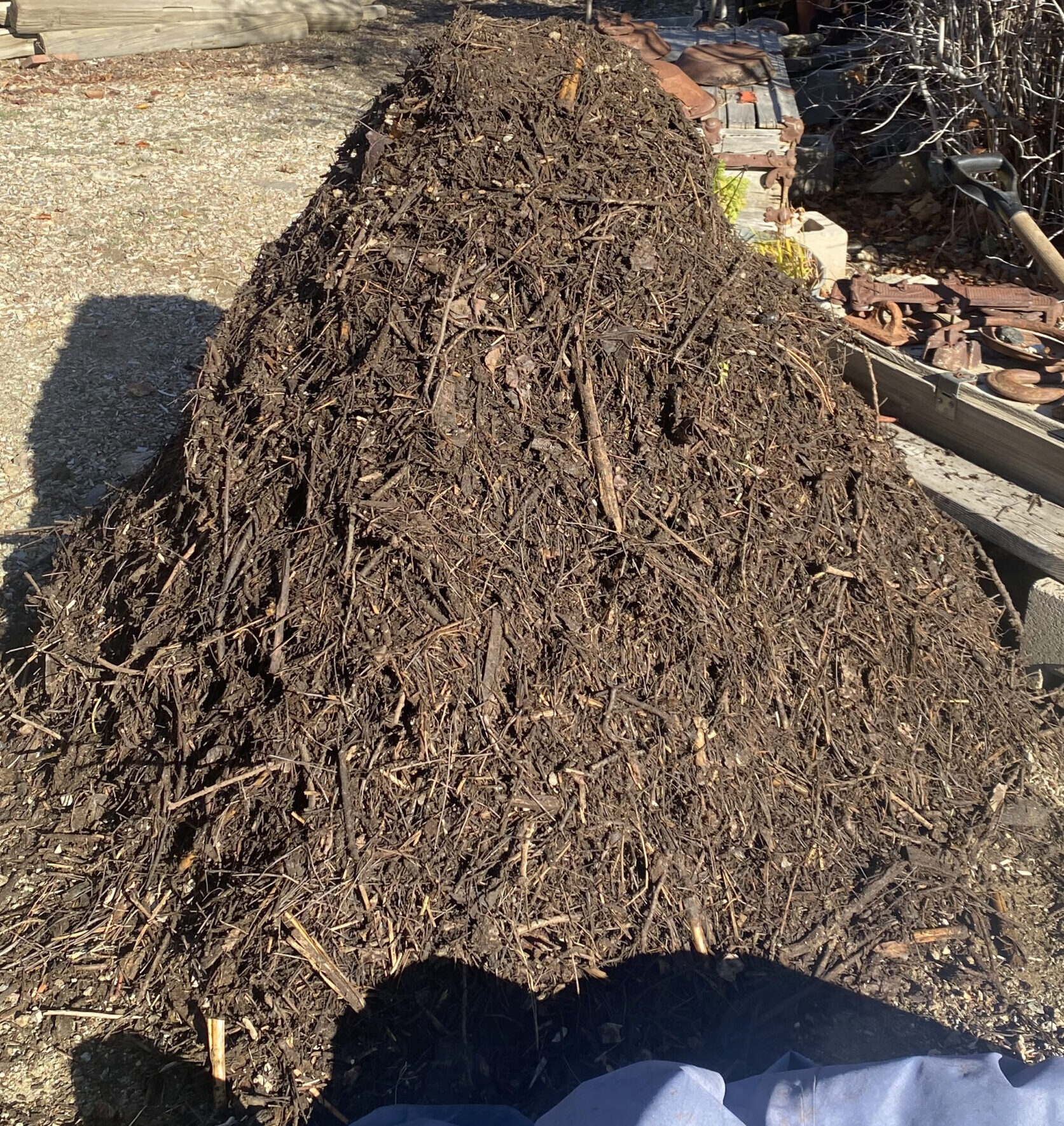
All Veg Compost
The Recipe:
 Collect materials – Grasses, *leaves, green stem shrubs, soft roots OK, generally any plant from a garden.
*Make it less woody, too much wood in the stack can cause heat distribution and water solubility issues.
*Collect approximately 1-2 square yards/meters each of
– Brown plant slash (less heavy on wood chips, softwood or very small chip hardwood)
– Green plant slash (at least 1/2 MUST be leguminous)
 *Collect approximately 40 gals (150 liters)
– Food scraps (everything from a kitchen except meats, eggs or oils)
– molasses, old grain flours
– kefir, komchucha, comfrey, alfalfa, yarrow, aloe vera etc.
– biochar (microbio habitat + increased micro surface area)
*For better results use many types of lignans for biochar, more varieties of charred materials will generate a more diverse micro-surface area.
– add redworm castings with food scraps, up to 1/2 a red worm farm/tower or up to 3-5 gallons (11-28 liters) castings.
1st Flip
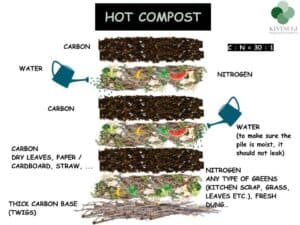
As with a Berkeley compost, layer each of your collected materials like a lasagna with adequate moisture, preferably sprinkled in, do not use heavy flow. Construct the pile beginning with a layer of dry brown slash then a layer of green (hopefully mostly dried) then foodscraps. Repeat a layer of brown, green, scraps.. Repeat until all collected materials are stacked up and end with a brown layer.
*If using inoculation, pour over the top near the end of initial pile construction or second and third flips.
*In dry climates, water absorption is slower and it might take an extra 2 days and 1 flip as the first flip is partially an absorption stage.
2nd Flip
add extra food scraps to the middle of the pile
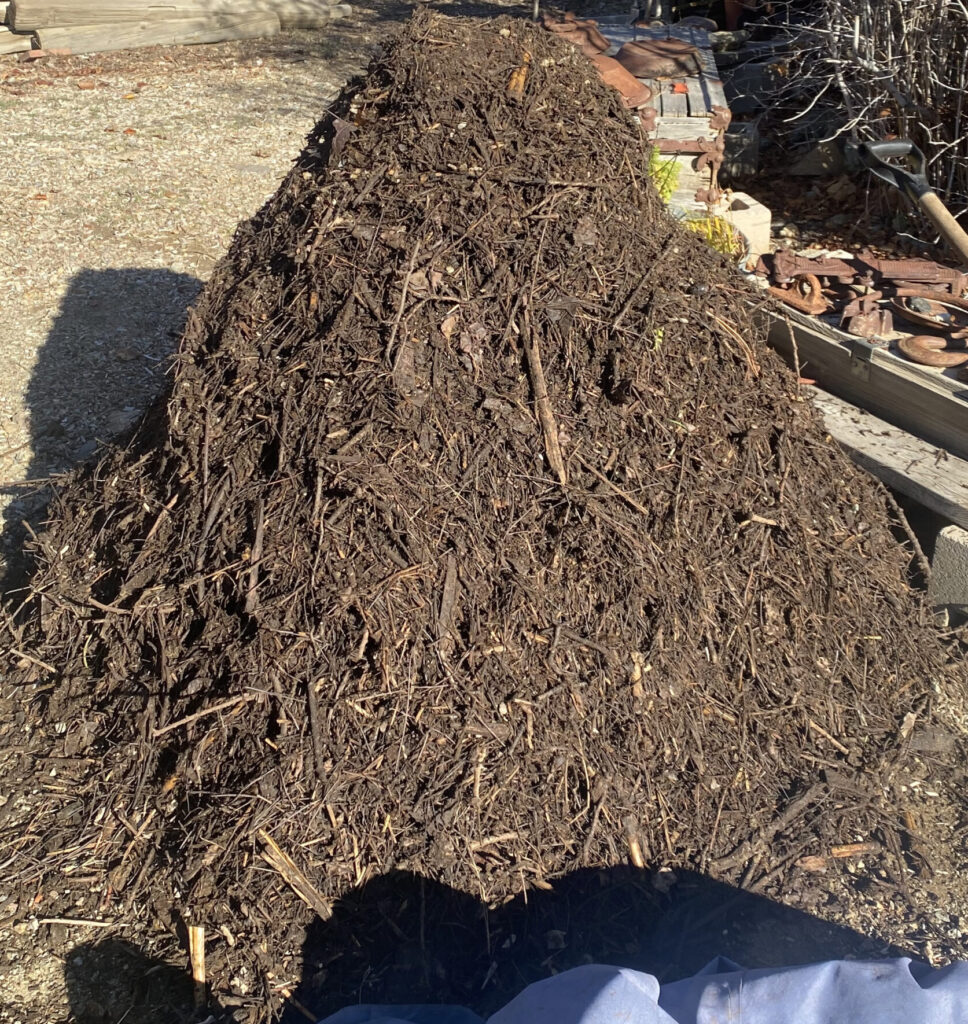
3rd Flip
add extra food scraps to the middle of the pile
4th Flip
add extra food scraps to the middle of the pile
Heat in the pile should begin to drop by the 4th to 6th flip. No more foodscraps are added at this point.
5th-9th Flip (dry/cold climates a few extra flips will help)
Repeat steps, maintain moisture
Optimally leave set for 14-30 days out of direct sun, if redworms/castings were added they will continue to process lignin fibers in the stack so long is does not get too dry.
But why make compost with no manure?
Other modern era problems
A high quality Berkeley compost typically may makes use of manure, potentially multiple sources. Modern communities have long eradicated domestic animals and most would have to travel to farms on the edge of their communities or rely on imported products. The common situation shrinks the ability to access compost components especially at the scale required.
If one has good quality manure ready to use, great! That will help make a high quality compost.
However If you have no access to manures, no worries! You can still make a great compost!
Additional reasoning:
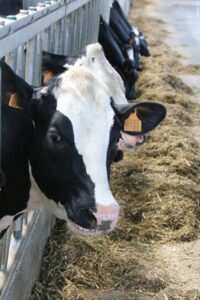
The overall health of the cattle industries world wide is in a constant battle with pandemics in animal communities. Since large scale operations are particularly susceptible to faster contamination, large resources of manure could be suddenly unavailable putting strain on food production systems at regional scales. Manures could at some point become scarce on a large scale. Composting industries would then also be strained and potentially unable to produce compost.
Is it economical?
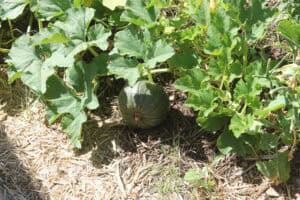
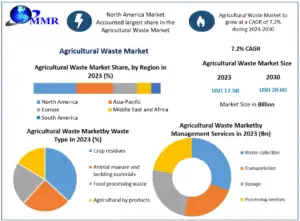 Yes! Most of the required materials are already thrown out as waste in most cases, with the exception of leguminous plants that in this recipe, are chopped for biomass. This ingredient may not be readily available for everyone. Some landscapes are abundant and in many different climates, however their are places with few to no legumes growing naturally in the landscape. Luckily there are numerous annual legume crops that can supply the needed N-rich biomass required to offset some of the nitrogen that would have come from manures.
Is it scalable?
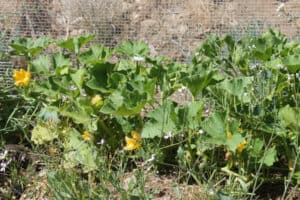 Potentially and in many landscapes but not all. Scaling the method without importing large amounts of resource requires a landscape survey includes evaluating invasive species as potential biostock and that the land that has at least some naturalized legume cover. *Management of legume species are required for this method.
Polycultures or diverse species of vegetation provide more size and shape variation in the breakdown of that biomass into fine particle compost as well as broadening the mineral and trace mineral gradient existing in the finished product.
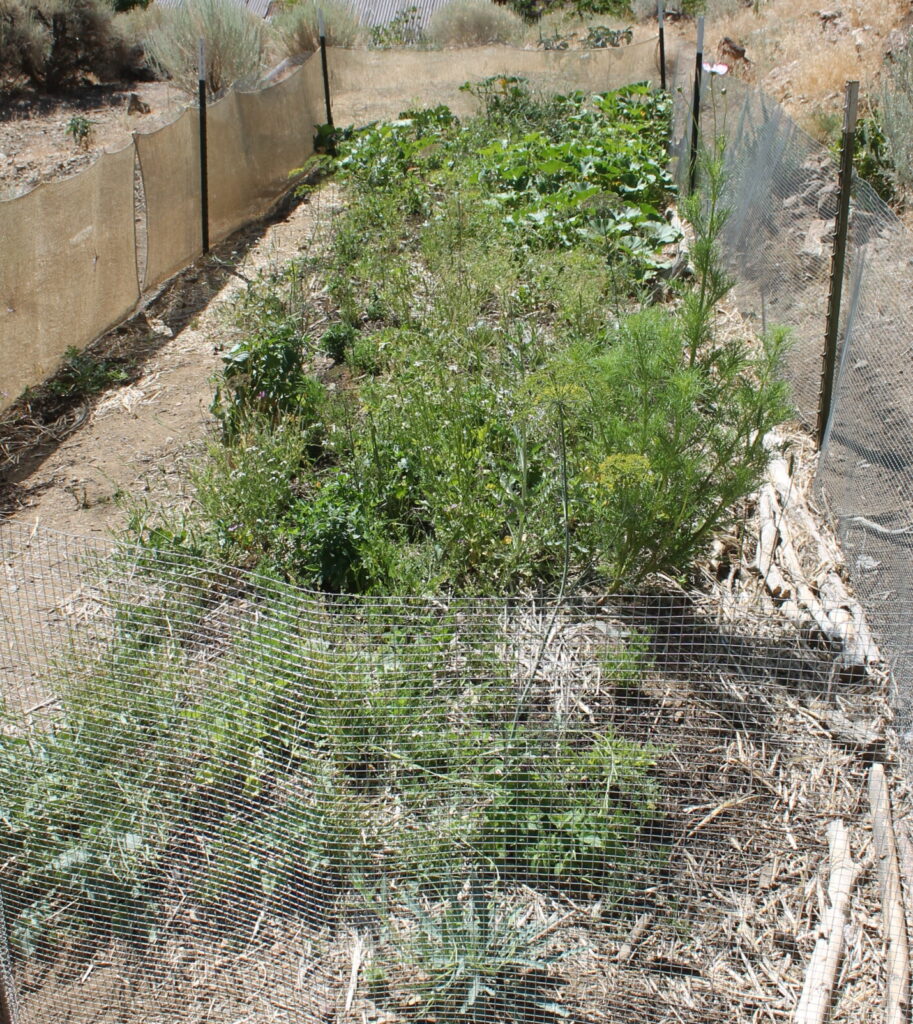
*As one square meter/yard of finished compost converts to a 30×3 production bed, when intensively cropped a similar 30×3 ft bed can produce 1 yard/meter sq brown and green slash for biomass up to 3 times in one season while providing food and pollination.
References:
“Quick Compost”, Discover Permaculture with Geoff Lawton – https://www.youtube.com/watch?v=CRSm4kIG5yk</a >
“Large-Scale Organic Materials Composting”, NC State Extension Publications – https://content.ces.ncsu.edu/large-scale-organic-materials-composting
“What Is Industrial Composting and How Does it Work?” – https://www.zerowaste.com/blog/what-is-industrial-composting/
“Breakdown of plastic waste into microplastics during an industrial Composting: A case study from a biowaste facility”, Science Direct Waste Management
Volume 203, 15 July 2025, 114889 – https://www.sciencedirect.com/science/article/pii/S0956053X25003009
“Effects of common microplastics on aerobic composting of cow manure: Physiochemical characteristics, humification and microbial community”, Journal of Environmental Chemical Engineering Volume 10, Issue 6, December 2022, 108681 – https://www.sciencedirect.com/science/article/abs/pii/S2213343722015548
“The Business Of Composting: How Food Waste Makes Money”, Eco Collective – https://www.ecocollective.earth/blogs/news/business-of-composting
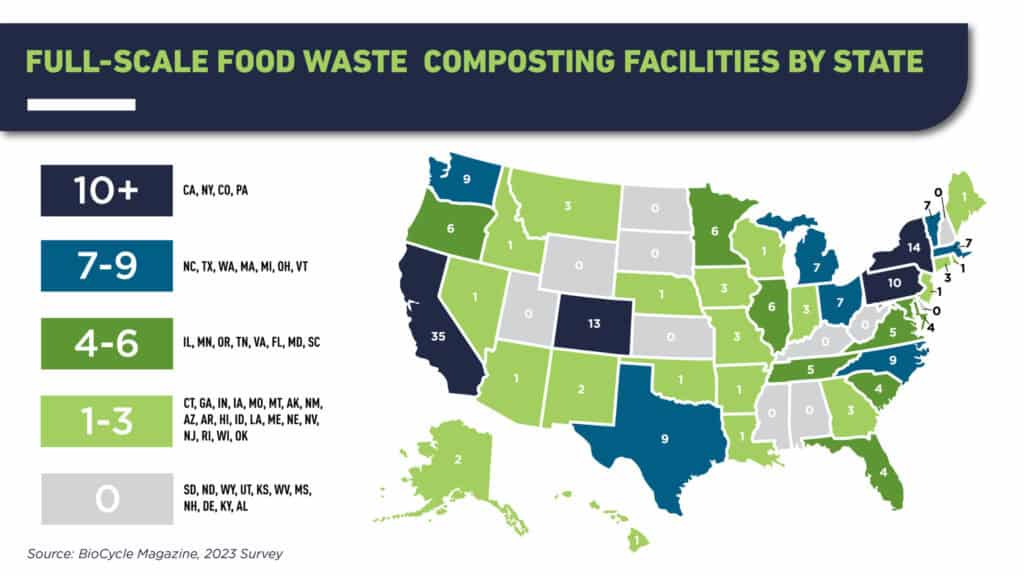
Map of Full-Scale Food Waste Composting Facilities by State, Eco-Products PBC – https://ecoproducts.com/support-composting?srsltid=AfmBOoowILzS4AlMIBo_IUB3OL36Nb5-GbC_owWqqACCTNMzihq5FQhT
“Agricultural Waste Market: Global Industry Analysis and Forecast (2024-2030)”, MAXIMIZE MARKET RESEARCH – https://www.maximizemarketresearch.com/market-report/agricultural-waste-market/214223/
The World Is So Desperate for Manure Even Human Waste Is a Hot Commodity by Sybilla Gross and Mumbi Gitau December 9, 2021 Bloomberg – https://www.bloomberg.com/news/articles/2021-12-09/global-shortage-of-fertilizers-sends-demand-for-dung-soaring
“Pie chart showing the composition of various organic manure types used by the farmers in the study.”, Aliyu, Kamaluddin & Shehu, Bello & Adam, Adam Muhammad. (2024). Digital technology in maize nutrient management research in northern Nigeria amid COVID-19 pandemic. Scientific Reports. 14. 10.1038/s41598-024-58740-1. – https://www.researchgate.net/figure/Pie-chart-showing-the-composition-of-various-organic-manure-types-used-by-the-farmers-in_fig6_379642485
“The effectiveness of the hot composting berkeley method as a soil amendment for cauliflower cultivation”, Cleaner Waste Systems Volume 12, December 2025, 100356 – https://www.sciencedirect.com/science/article/pii/S277291252500154X
“WASTE MANAGEMENT IN THE CIRCULAR ECONOMY UNSEEN ZOONOTIC RISKS”, QUAESTUS MULTIDISCIPLINARY RESEARCH JOURNAL – https://www.proquest.com/openview/d9ead8258f37f265939e484d55dd7422/1?pq-origsite=gscholar&cbl=2040113
“Insights into bacterial diversity in compost: Core microbiome and prevalence of potential pathogenic bacteria”, Science of The Total Environment Volume 718, 20 May 2020, 137304 – https://www.sciencedirect.com/science/article/abs/pii/S0048969720308147