
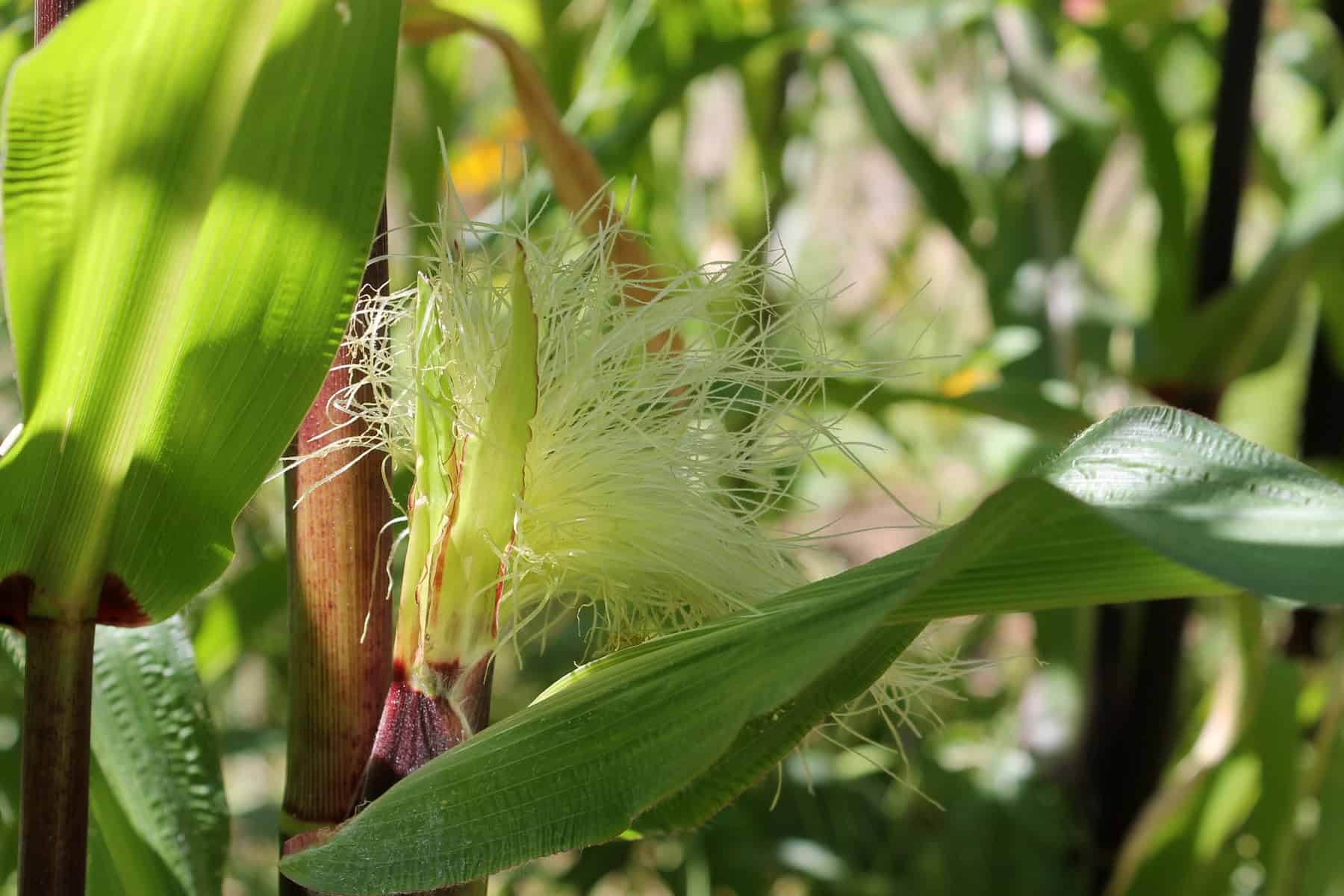
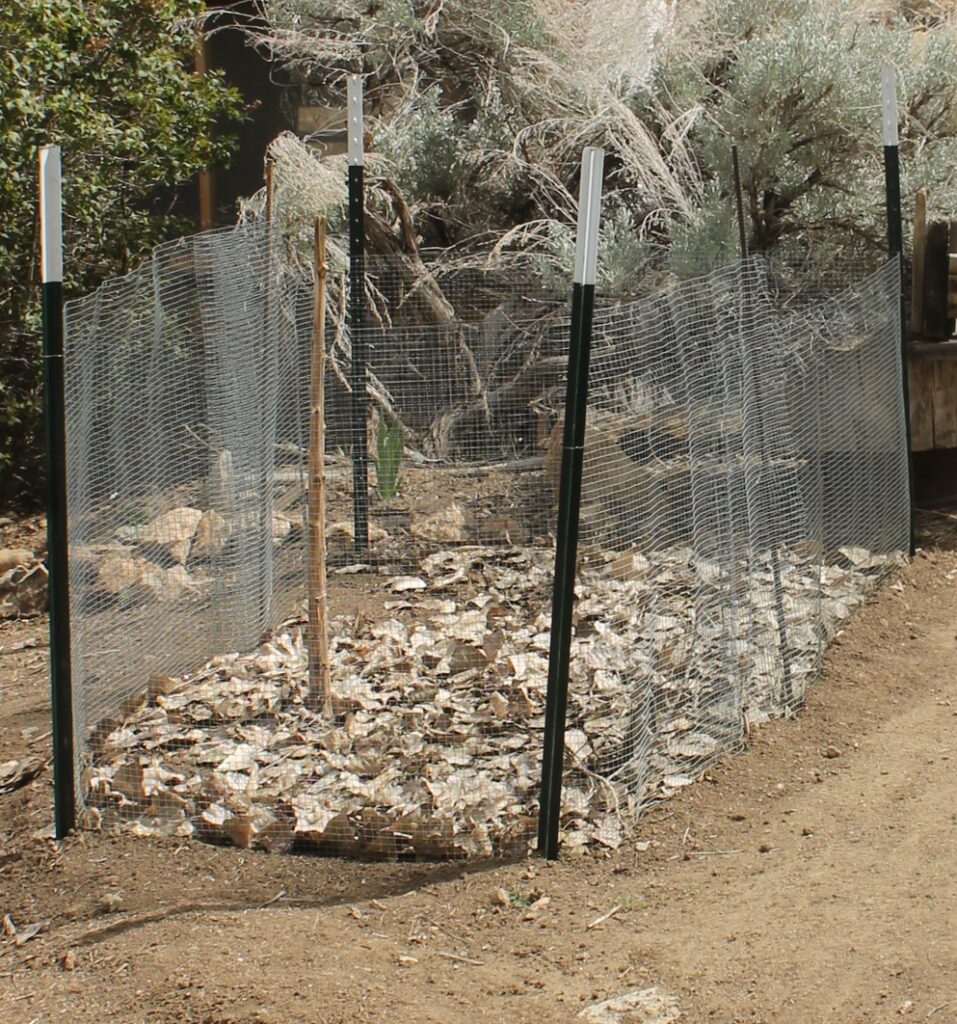
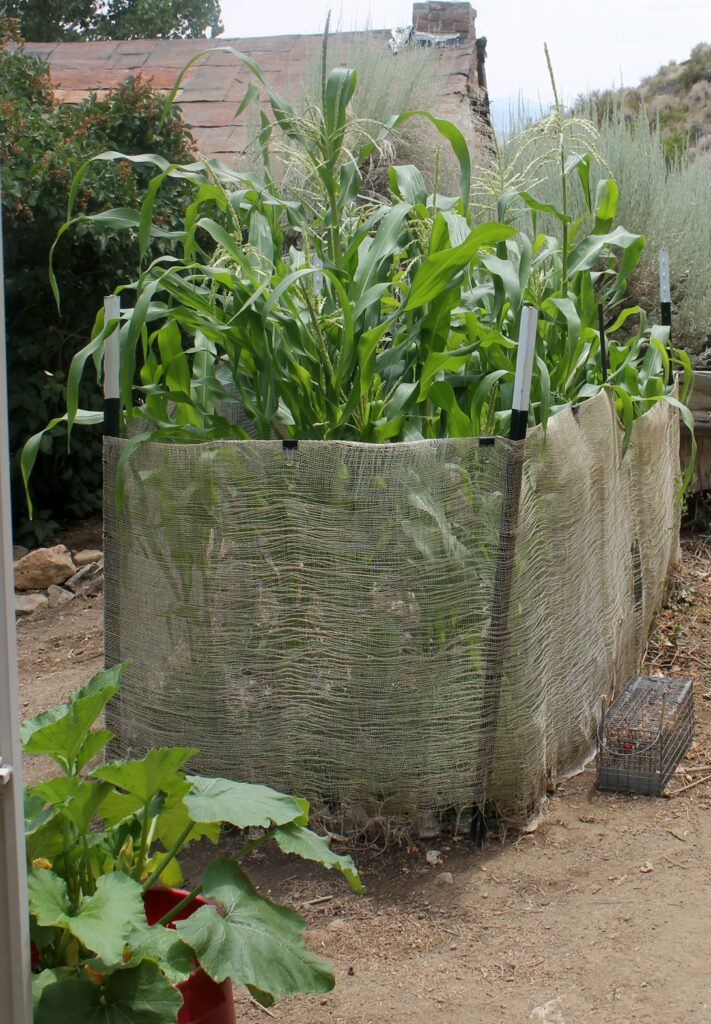
Grains produce quickly in summer, this results in annual pulses of plant detritus each winter. AMF(Arbuscular mycorrhizal fungi) and VAM(vesicular arbuscular mycorrhiza) inhabit fallen detritus through winter’s cooler season, the AMF and VAM activity during this period primes the soil for grains by hyper-activating the uptake of macro-nutrients with the assistance of root rhizomes around the hairlike roots of grains that form in a layer situated between native soil and root cell walls. For the grains the layer of mycelium and rhizome functions as an insulator and distributor of water and nutrients, namely nitrogen and phosphorus. (1)
Focusing on the relationship between corn and lentils, mycelium functions as connective highway between plants and the rhizomes that inhabit their root systems. Mycelium creates a sheet-like layer through the topsoil that physically traps and distributes moisture, the organisms involved are all leveraging this factor to their advantage. Mycelium also seeks out nutrient far beyond the reach of the rhizome-plant relationship while connecting them to it. The benefit for mycelium to grow in this way to actively harvest sugars from plants while utilizing micro-habitats of the host plants. (2)
Research has shown that lentils and corn sown together produces a unique symbiotic relationship where nitrogen uptake is increased by assisting microbiology, at the same time phosphorous is uptake is also enhanced. Both plants are actively supporting one another. Grain plants are a good host for AMF/VAM and lentils benefit greatly from the phosphorous enhancement near grains root system. At the same time the grain plant is actively fed more nitrogen from rhizomes associated with the lentil. (3)
When AMF/VAM thrives through seasons, the continual breakdown of detritus from the environment feeds the soil microbes before subsequent warm season. This creates a continual boom for grains so long as the soil is not overly disturbed, over cleared, burned or chemically treated. This factors in nicely with polyculture production and “chop n drop” style management. (4)
By adding occasional biochar amendments soil microbes are provided dramatic increase in surface area and minerals that absorb toxins and lower salinty. General toxicity in the soil is reduced while water storage is increased (5a, b). Applying this type of amendment in the winter season correlates with natural cycles, available biomass and helps moderate large pulses of nutrient that generally come with warm seasons in agricultural regions. Adding biochar to compost processes streamlines the application for applying beneficial microbes AMF/VAM and biochar for crops by utilizing local slash as a source of biomass. (6)
Most environments host AMF/VAM or AMF. For this example, sage brush, cheatgrass and cottonwoods are a primary source for seasonal flows of biomass. All three are generally associated with AMF/VAM during decomposition. Many invasive species are purpose built AMF collectors in both in where they tend to exist and how their structure breaks down in the landscape. Targeting invasive-habit species for biochar amended compost appears as a excellent match for grains and lentils producing soils (7).
This example shows that even in generally non-arable soils, understanding AMV/VAM cycles in the landscape can help shift difficult soils into production. A soil’s structure and is it’s physical limitations are inherent from it’s geology. This example’s soil type is cobbly loam with heavy mineral clay and nearly equal proportions of silt and sand. The raw material of the soil comes from the breakdown of rhyolitic and andesite lava and quartzite (8). The iron and other heavy metals leached from the volcanic rock accumulates into the clay in the soil. These cations in the soil bond with nitrogen to form a molecular lock that is not easily broken by seasonal changes which provides a unique challenge for nitrogen needy summer crops in dry conditions.
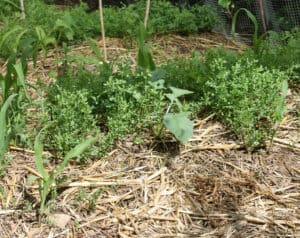
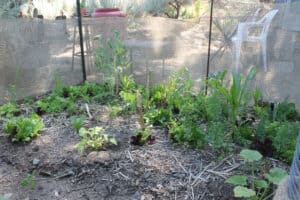
Situating crop rows on contour further benefits mycelium function around grain plant root system amplifying the grove effect of the lentils as cover crop and grains so that is is possible to sow other crops as the grains mature. Several harvests are possible in the under-story of the grains using short term crops such as lettuces or radish.
Occupying spaces between trees shelters the grain from drying winds and reduces use of high yield food production spaces. Positioning the rows or beds on contour and stacked down slope helps move pollen through the patch for better pollination. The space between rows of trees causes a Venturi effect that drafts air through the grain patch further assisting air pollination.
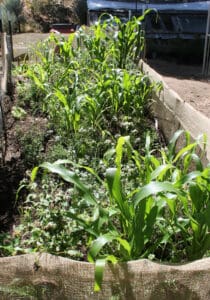
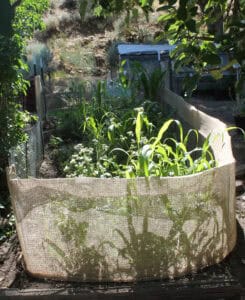
Multiple cuttings of lentils through the season adds pulses of nitrogen as the season warms.
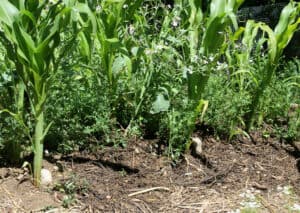
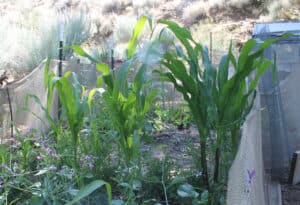
Excess nutrient is absorbed by intensive short term crops and greatly benefited by the repeated chopping of lentil biomass. Shading and transpiration from short term crops helps nurture grains so stalks grow thick, an issue in high and dry environments where drying effects and warmth of the season coincide which can cause crop failure. (9)
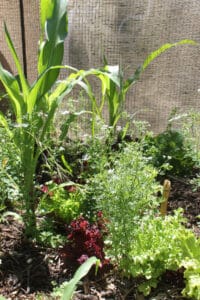
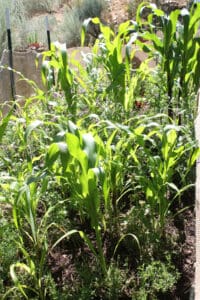
Short term crops expire before grains like corn are fully mature. The expiring plant roots feed the soil food web later through the season when surrounding soils go dormant due to water scarcity.
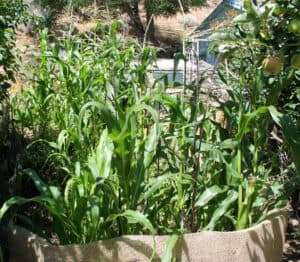
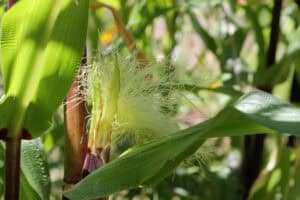
For climates with short growing seasons repeat sowing of the grain seed allows for late frost avoidance in April to June and creates the option for harvesting later into the season.
References:
Naheeda Begum, Cheng Qin, Muhammad Abass Ahanger, Sajjad Raza, Muhammad Ishfaq Khan, Muhammad Ashraf, Nadeem Ahmed, Lixin Zhang DOI: 10.3389/fpls.2019.01068(2) Evolutionary history of mycorrhizal symbioses and global host plant diversity. Mark C. Brundrett, Leho Tedersoo. 22 January 2018 https://doi.org/10.1111/nph.14976
(2) Impact of growth and uptake patterns of arbuscular mycorrhizal fungi on plant phosphorus uptake-a modelling study. Andrea Schnepf & Tiina Roose & Peter Schweiger Plant Soil (2008) 312:85–99 DOI 10.1007/s11104-008-9749-3 https://pmc.ncbi.nlm.nih.gov/articles/PMC6410211/
(3) Increasing diversity gradient in lentil mixtures for intercropping with wheat reveals an increase in lentil biomass with minimal impact on mycorrhizal activity. Elisa Lorenzetti, Federico Leoni, Gilbert Koskey, Paolo Bàrberi Scuola Superiore Sant’ Anna, Center of Plant Sciences, Group of Agroecology, Piazza Martiri della Libertà, 33, 56127, Pisa, Italy https://doi.org/10.1016/j.rhisph.2023.100824
(4) Permaculture Management of Arable Soil Increases Soil Microbial Abundance, Nutrients, and Carbon Stocks Compared to Conventional Agriculture. Rose Frances Williamson, Michaela Reay and Fotis Sgouridis, School of Geographical Sciences, University of Bristol, Bristol BS8 1SS, UK https://ui.adsabs.harvard.edu/abs/2024EGUGA..2619083W/abstract
(5) a. Arbuscular mycorrhizal fungi reduce arsenic uptake and improve plant growth in Lens culinaris. Mohammad Zahangeer Alam, Md. Anamul Hoque, Golam Jalal Ahammed, Lynne Carpenter-Boggs. Department of Environmental Science, Faculty of Agriculture, Bangabandhu Sheikh Mujibur Rahman Agricultural University (BSMRAU), Gazipur, Bangladesh, Department of Soil Science, Bangladesh Agricultural University (BAU), Mymensingh, Bangladesh, Department of Crop and Soil Sciences, Washington State University (WSU), Pullman, WA, United States of America, College of Forestry, Henan University of Science and Technology, Luoyang, PR China https://pubmed.ncbi.nlm.nih.gov/31095573/
b. Arbuscular mycorrhizal fungi in alleviation of salt stress: a review. Heikham Evelin , Rupam Kapoor and Bhoopander Giri. Applied Mycology Laboratory, Department of Botany, University of Delhi, Delhi-110 007, India and Department of Botany, Swami Shraddhanand College, University of Delhi, Delhi-110 036, India. Annals of Botany 104: 1263– 1280, 2009 https://doi.org/10.1093/aob/mcp251
(6) “Biochar and Arbuscular Mycorrhizal Fungi Play Different Roles
in Enabling Maize to Uptake Phosphorus”. Mengying Li, and Liqun Cai. College of Resources and Environmental Sciences, Gansu Agricultural University; Gansu Provincial Key Laboratory of Arid land Crop Science, Gansu Agricultural University, Lanzhou 730070, China https://doi.org/10.3390/su13063244
(7) “Formation of mineral-associated organic matter in temperate soils is primarily controlled by mineral type and modified by land use and management intensity”. De Shorn E Bramble, Susanne Ulrich, Ingo Schöning, Robert Mikutta, Luise Brandt, Christian Poll, Ellen Kandeler, Christian Mikutta, Alexander Konrad, Jan Siemens, Yang Yang, Andrea Polle, Peter Schall, Christian Ammer, Klaus Kaiser, Marion Schrumpf. Glob Chang Biol . 2024 Jan;30(1):e17024. doi: 10.1111/gcb.17024. Epub 2023 Nov 20. https://pubmed.ncbi.nlm.nih.gov/37986273/
(8) Soil Survey Geographic (SSURGO) Database for Lyon County, Nevada. United States Department of Agriculture, Natural Resources Conservation Service, 2026, websoilsurvey.nrcs.usda.gov/app/. Accessed 3 March 2026.
(9) Effect of drought and heat stresses on plant growth and yield: a review**. J. Lipie1, C. Doussan, A. Nosalewicz1 and K. Kondracka1 Int. Agrophys., 2013, 27, 463-477 https://doi.org/10.2478/intag-2013-0017